


Technology
AI In The Family Office: Lessons For Asset, Wealth Managers
.jpg)
This report – one of several – from the investment summit in Manhattan last month recounts discussions on the use of artificial intelligence in the investment process, and considers where developments might be headed.
Here is another of our reports from the 11th Family Wealth Report Family Office Investment Summit 2025. (See an overview article from the summit here by our US correspondent.) Unsurprisingly, given the level of interest in the topic this year, AI featured as an important discussion point.
The following is an account of the panel discussion of experts from PwC (pictured below).
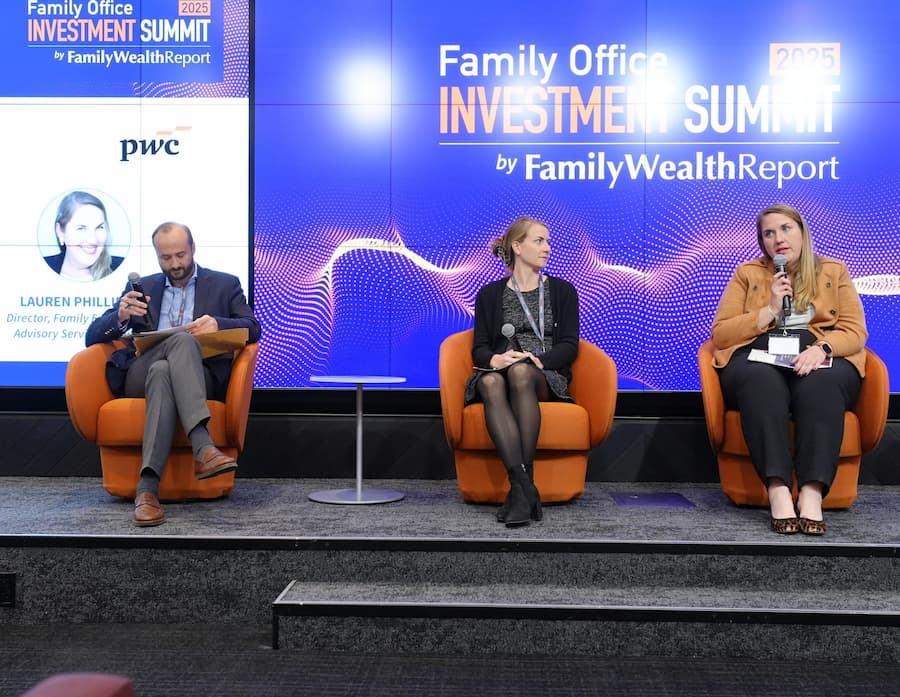
Speakers at the panel, left to right: Peter Bixler, senior manager, Family Enterprise Advisory Services, PwC; Kristin Christine, director, Asset Management Advisory Practice, PwC, and Lauren Phillips, director, Family Enterprise Advisory Services, PwC.
AI is accelerating innovation across asset and wealth management – reshaping business models, workflows, and operations. Family offices are evolving beyond traditional wealth stewardship – and many are starting their AI journey, exploring how to integrate it responsibly. Institutional use cases don’t always translate directly to family offices, but many lessons apply – and there are clear opportunities to right-size AI adoption.
How AI is reshaping private markets
Many institutional managers with
private-market-focused-strategies are already adopting AI across
the fund lifecycle and core corporate activities. The
main areas where AI is being implemented
are investment workflows, fundraising processes, and
investor communications. Firms are starting to explore solutions
in middle and back-office functions as well – but those are often
tied into larger, more traditional transformation projects.
Investment processes have traditionally been largely manual and document intensive – AI is changing that – enabling more automated diligence processes and streamlined sourcing tasks. Firms are leveraging both general purpose AI tools as well as tools designed specifically for private markets. Tactical solutions are emerging aimed at improving effectiveness and speed in the deal process – such as drafting investment committee memos, summarizing data room documents, and extracting terms from credit agreements or customer contracts. Firms are also exploring solutions aimed at improving decision-making – such as opportunity screening and investment committee preparation tools.
AI in the family office
Family offices are at different stages of their AI journey. Many
are starting with low risk, practical uses, and exploring the
governance needed for safe adoption. In terms of specific tools,
family offices are typically looking toward capabilities already
present in their existing tech stack, with a focus on safe,
integrated workflows. So called “citizen-led” adoption is also
common currently, as staff utilize readily available
enterprise tools for immediate productivity gains, speed, and
insight.
While custom built applications are far more common amongst larger scale institutions, family offices are following investment managers in using AI for due diligence, research synthesis, and portfolio analysis. Many are focusing on summarization and research use cases, where AI can reduce manual effort without adding operational risk. A standout use case is trust agreement summarization, where AI extracts key provisions and supports Q&A to determine whether transactions are allowable. The same approach applies to partnership and operating agreements, helping automate reviews that once required senior-level review. Overall, AI adoption in family offices is about enhancing human expertise, improving productivity, and building confidence in responsible automation. AI isn’t replacing expertise – it enhances it and helps teams build confidence in responsible automation.
AI readiness and strategy
Family offices share several foundational requirements for
effective AI adoption. Many centralize their approach while
tailoring support to small, specialized teams. Use cases are
prioritized and sequenced based on criteria including impact,
time to value, scalability, and risk profile. Roles,
organizational structures, and processes are defined with a focus
on integration with current operating models. Cross-functional
oversight bodies are established to oversee risk and remove
roadblocks. Training and proactive communication are employed to
support cultural and behavioral shifts. Other key strategies for
adoption include the integration of AI into reviews, implementing
AI workshops, monitoring adoption metrics, and
tracking AI-specific key performance indicators.
Data readiness is the foundation of successful AI adoption. When data is precise, consistent, and connected, AI delivers powerful insights.
Equally important is strong governance and clear access controls to help protect sensitive family information and build trust.
What’s next for family offices?
As institutional managers advance their use of AI, family offices
are building their own momentum. Practical workflows and
citizen-led adoption are laying the groundwork for broader,
responsible integration.
We expect the initial focus on citizen-led usage to evolve further; increasing adoption, alongside the realization and measurement of value, is testament to AI becoming an integral part of daily work. As adoption accelerates, AI will likely become a natural part of daily decision-making.