
The following article is from Marianna Mamou, head of advice beyond investing, Chief Investment Office Global Wealth Management at UBS Global Wealth Management, part of UBS.
The editors are pleased to share these views; the usual editorial disclaimers apply to views of outside contributors. To comment, email tom.burroughes@wealthbriefing.com and amanda.cheesley@clearviewpublishing.com.
For many people, their relationship with money begins in childhood. Children learn from what their parents say, the decisions they observe and the financial responsibilities they are encouraged to take on. These everyday experiences help shape their attitudes towards spending, saving and managing money.
The UBS Financial parenting: Preparing the next generation for financial wellbeing report explores how parents can support this learning through conversations, example and practical experience. For families preparing for wealth transfer, it also provides a starting point for helping the next generation understand the responsibilities of managing inherited wealth.
Financial parenting involves helping children acquire the knowledge, skills and tools to make financial decisions, and develop the habits and judgment to use them effectively. Children can learn by making small, everyday financial decisions, experiencing the consequences and reflecting on what they would do differently.
The inheritance conversations families are not having
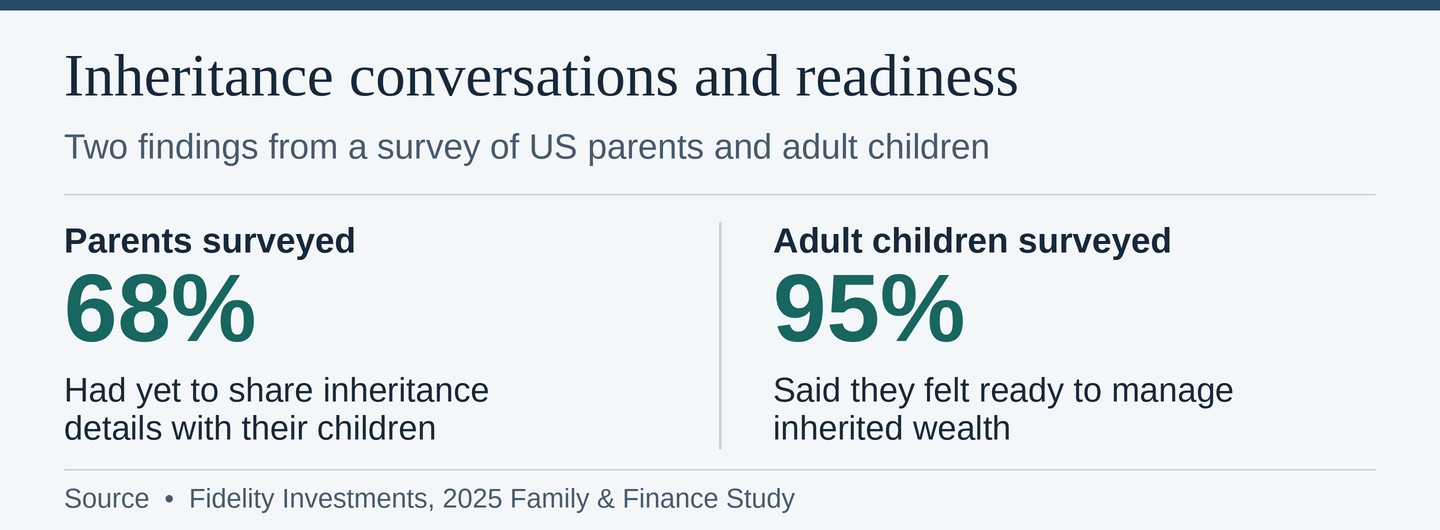
A 2025 Fidelity survey, cited in the UBS report, found that 68 per cent of parents surveyed had not shared inheritance details with their children, while 95 per cent of adult children said they felt ready to manage inherited wealth.
Sharing information about an inheritance is not the same as preparing children to manage it. Disclosure and preparation are distinct tasks. Families need to consider both what information to share and how to help children develop the judgment to manage inherited wealth responsibly.
Parents may be reluctant to discuss wealth for understandable reasons. Some worry that disclosing too much information could undermine motivation, encourage entitlement or create anxiety. Others may simply be uncertain about when to begin these conversations or how much information is appropriate to share.
However, avoiding the subject can carry its own risks. Without an understanding of the family’s wealth, future heirs may struggle to grasp the responsibilities that come with it. They may also be unfamiliar with the decisions and values that shaped it.
Families can begin by discussing the purpose of wealth, the importance of financial independence and the responsibilities that come with having resources, before gradually introducing more detailed information about inheritance arrangements. This can help make wealth transfer a process of preparation rather than a single moment of disclosure.
The money messages children inherit
Financial education extends beyond formal discussions about saving, investing and inheritance. Children’s attitudes towards money are also shaped by the financial behaviours and 'money messages' they observe throughout their upbringing.
Explicit messages might include guidance on budgeting, saving for a goal or giving to charitable causes. Implicit messages are communicated through everyday behaviour, such as how parents approach spending, respond to market volatility or discuss financial uncertainty.
For example, parents who consistently avoid discussing money may unintentionally communicate that finances are a private or uncomfortable subject. Equally, parents who react anxiously to market movements may reinforce the perception that financial uncertainty is something to fear.
Research cited in the report suggests that children may pick up their parents’ attitudes towards investing and risk, including overconfidence, loss aversion and the illusion of control.
Importantly, there is no single approach to financial parenting that will suit every family. What matters is that parents recognise the messages they may be passing on and consider whether those messages will support their children's long-term financial wellbeing. This may involve demonstrating the importance of financial discipline, even when financial security is assured, recognising the trade-offs involved in investment decisions, and understanding how wealth can create opportunities to benefit others as well as oneself.
Why parental role models and early conversations matter
Research by the FINRA Investor Education Foundation and CFA Institute, cited in the UBS report, offer a useful comparison of parental conversations among Gen Z investors and non-investors.
Among those surveyed, 79 per cent of Gen Z investors reported having parents who discussed investing with them, compared with 46 per cent of Gen Z non-investors.
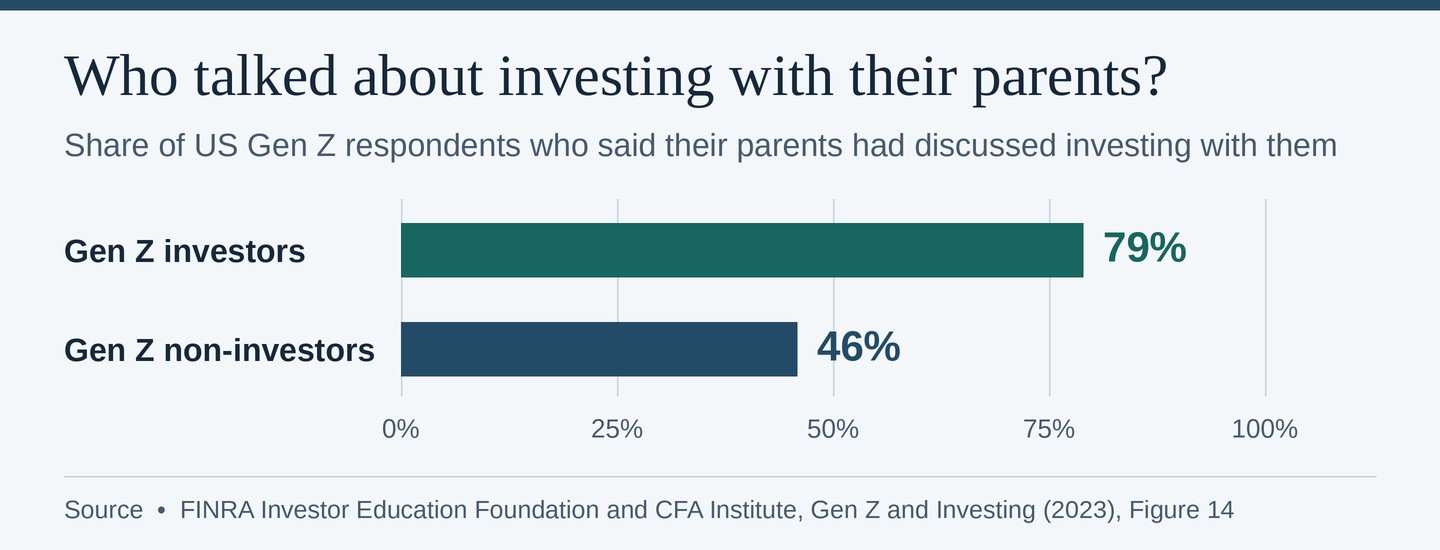
These findings suggest an association between family conversations and young adults’ participation in investing, rather than proving that parental engagement encourages children to invest.
What successful wealth transfer looks like
Ultimately, successful wealth transfer involves more than ensuring that the appropriate legal and financial structures are in place. It also means equipping future wealth holders with the judgment and confidence to make decisions independently.
This is best approached as a gradual process, with financial responsibilities increasing as children demonstrate readiness rather than simply reaching a particular age. Readiness can be seen in the ability to accept limits, explain a trade-off, learn from a mistake and ask for advice before a consequential decision.
For younger children, financial education might begin with distinguishing between needs and wants, setting savings goals and making small spending decisions. Teenagers can begin exploring budgeting, investing, diversification and the relationship between risk and return. As children reach adulthood, families can introduce more complex responsibilities, such as participating in family investment discussions, managing defined budgets or contributing to philanthropic decisions. These experiences can provide opportunities for developing financial capability.
Philanthropy can be particularly valuable for encouraging conversations about family values and the responsibilities that come with wealth. Similarly, early involvement in family governance and investment decisions can help future heirs understand how and why wealth is managed. There is no universal schedule for these financial conversations. The appropriate level of disclosure and responsibility will depend on individual maturity, family circumstances and the complexity of the wealth involved.
Regardless of when the conversations take place, a successful wealth transfer should equip the next generation with the confidence to ask questions, the discipline to consider long-term consequences and an understanding of how wealth can support both personal ambitions and wider family values.
As the Great Wealth Transfer gathers pace, families that begin these conversations early may be in a better position to prepare the next generation for the responsibilities ahead. After all, the true measure of successful wealth transfer lies not in how much the next generation inherits, but in how well prepared they are to manage it.