
Participants at the 11th Family Wealth Report Family Office Fintech Summit were invited on the day to complete a survey exploring technology priorities, AI adoption and investment plans. The findings offer a snapshot of where respondents see the greatest opportunities, alongside the barriers and safeguards shaping adoption.
Survey findings point to practical uses for AI, rising technology budgets and a clear demand for security, reliable results and implementation support.
Some 79 per cent expect AI and automation to have a major impact over two years, 63 per cent already use AI, and 79 per cent expect technology spending to rise.
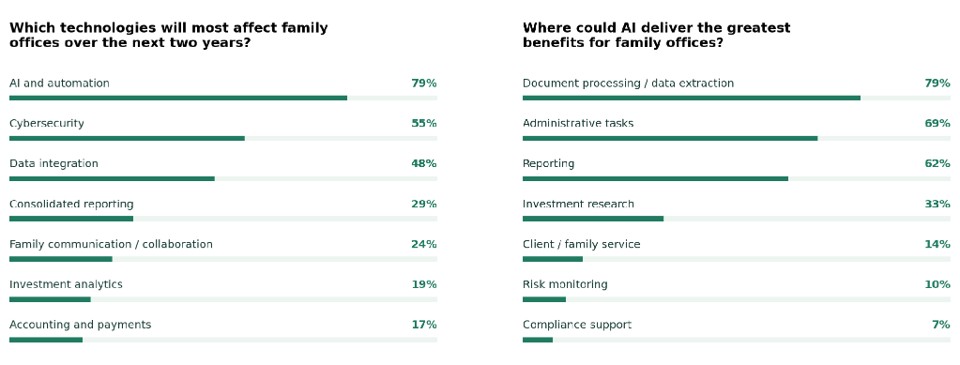
Other AI value write-in answers: development 2 per cent; all areas 2 per cent.
Adoption is moving into daily work
Among those answering the adoption question, 63 per cent already use AI extensively or in selected activities. Another 22 per cent were testing or piloting it, while 10 per cent were exploring opportunities and 5 per cent were not considering it.
This points to engagement across several stages of adoption. However, extensive use was reported by 32 per cent, so the results should not be read as evidence that AI is fully embedded across most organizations.
The expected impact of AI also sits alongside strong interest in cybersecurity and data integration. Taken together, these priorities suggest that adoption will depend on the quality and security of the systems supporting it.
Practical workflows come first
Document processing and data extraction led the potential uses for AI, followed by administration and reporting. These applications offer potential efficiency and cost benefits. The question did not define value solely in monetary terms, and the survey did not measure financial returns.
Investment research attracted 33 per cent, while client and family service received 14 per cent. This does not establish that these applications have less long-term potential; it shows where respondents currently see the greatest value.
For family offices considering their next step, the findings support a focused approach: identify a recurring task, define the desired improvement and assess the quality of the output before extending use.