
Family offices find themselves on a highwire balancing act between keeping up with fast changing artificial intelligence technology and looming privacy and security concerns.
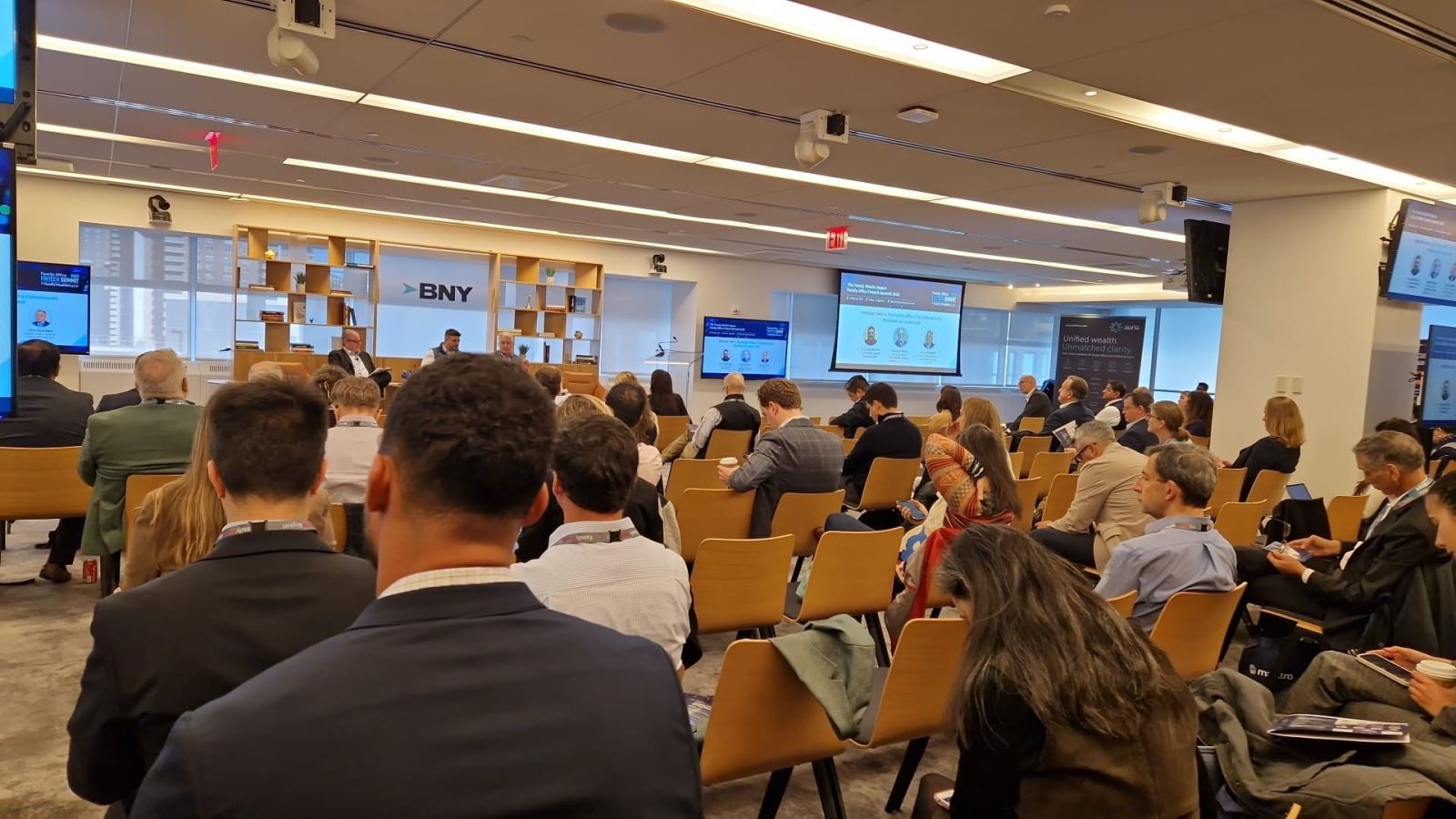
“Privacy must be a higher priority than being on the frontier of AI,” said David Sawyer, CEO of Unlimited AI, speaking at Family Wealth Report’s annual Family Office FinTech Summit in New York. “Family offices have to have privacy as their north star,” added Murali Nadarajah, global head of R&D and AI for Eton Solutions.
Privacy and security concerns centered on both the personal devices of family members and the family office itself.
The privacy of the family’s principal can be hacked “more easily than the server,” warned Paul McKibbin, the former leader of the Americas Family Office Advisory Practice at EY.
Within the office, “shadow AI,” employed by family office staff who are told not to use artificial intelligence but do so anyway is a “big concern,” said Dean Palmiter, CEO of family office software firm Asseta.
Family offices should have an “incident response plan” in place, said FORT Advisors executives Matt Lamura, the security firm’s founder and principal Alex Waintraub, who heads the firm’s SecOps division. They outlined a military-style “left and right of boom” plan that detailed action plans for before and after a security breach.
EDR now table stakes; cloud fears overblown
Having next-generation anti-virus software EDR in place is now “table stakes,” Waintraub said. If a data breach does occur, servers shouldn’t be rebooted, and while data recovery is important, it doesn’t resolve the crisis, he told conference attendees, adding that incident response plans need to be regularly updated.
An audit trail for documents within the system of record is critical, said Palmiter. Data breaches “will become more commonplace,” as AI advances, said Ken Eyler, managing director of Emigrant Family Office, making a protocol for security best practices essential.
Those best practices should include independent verification for data entries and outcomes, said Serge Bourlatski, COO and CFO of New York City family office Malkin Holdings. Family offices should also create a secure path for data with “thoughtful details” that can be verified, added Edward Van Deman, CEO of accounting and financial reporting platform Forest Systems.
Making sure proprietary data doesn’t leak into AI systems is also critical, said Brian Smeddy, head of operations at Bessemer Securities. “Zero data retention is a really big deal,” he emphasized. However, security fears about storing data in the cloud are overblown, according to Van Deman. Data should be secured by good cloud providers, and not moving data to the cloud means “losing too many opportunities for data reporting,” he said.
“AI helpful, but we have a long way to go”
When it comes to the fast pace of AI technology, family offices have the luxury of a longer time horizon than wealth management firms, speakers at the conference noted. Nonetheless, while family offices are rapidly adopting AI adoption, they are also grappling with implementation.
“AI is really helpful, but we have a long way to go,” said Smeddy, summing up the general sentiment among family office executives.
Using AI for back and middle office functions is analogous to digging a hole for a swimming pool with a backhoe instead of a shovel, said Jason Beutler, CEO of AI firm Robosource. Family offices have benefited from AI’s ability to simplify coding and process data, but the technology has also added risk and complexity, said Kegan Burke, eastern director of sales for bill pay firm AgiLink.
“A data stack is more important than a tech stack”
Conference speakers also emphasized the importance of taking care of proprietary data, urging attendees to have a primary, secure source of data that is protected from third-party risk.
“A data stack is more important than a tech stack,” said Van Deman. “Family offices need to think of data first and building on that, then adding AI integration. They need to maintain data consistently and then they can pick and choose AI apps.”
As family offices move forward with AI, they were urged by Tomas Hurcik, CEO of Orca, a Swiss-based family office platform, to keep in mind that AI tools are “largely probabilistic” rather than deterministic and to use “objective benchmarking” to gauge an application’s effectiveness. Artificial intelligence can make great suggestions, Hurcik said, but he doesn’t yet trust the technology’s ability to execute.
“I love AI but I don’t trust it all”
As Beutler put it, “I love AI but I don’t trust it all. At the end of the day, there has to be a human in the loop to make the final decision.”
Since AI models are changing so rapidly, Hurcik urged family offices to constantly verify and, when considering what to buy, “match the tool with the cost of being wrong.” An MCP server that combines data from multiple AI systems can help homogenize data for final analysis, he added.
Ultimately, adopting AI is more of a cultural problem within the office than a tech problem, Beutler said. Most people still treat AI like a Google search, he said, and “don’t know what they’re doing.”
Tech demos
The Fintech Summit also included presentations from 10 leading software companies:
Asseta CEO and co-founder Dean Palmiter demonstrated the AI-native operating system’s Intelligent Family Office Suite, combining general ledger, partnership accounting, banking bill pay and investments.
Bill.com’s Sean Picard described the bill pay company’s financial management offering for family offices that combines security, automation and compliance, including integrated workflows, fraud prevention and customized controls.
Unlimited.ai’s founder and CEO David Sawyer displayed how the company’s AI-based investment platform’s automates complex portfolio management and family office intelligence operating systems.
Eton Solutions uses AI to combine investments, accounting, reporting and documents on a unified platform, Stuart Guidry, vice president of platform consulting, told conference attendees, enabling family offices to discard disconnected systems, fragmented data and manual workflows.
Masttro’s director of sales Eric Switzer demonstrated the financial management software company’s Cash Projection Hub, which models commitments, distributions and cash flow for closed-end funds out to 10 years.
Advyzon’s Nikhil Deusana displayed Auria, which puts ownership structures, entities, investments alternative assets documents and reporting on a single unified platform.
Forest Systems customer service engineer Dylan McArthur demonstrated the firm’s cloud-based accounting and financial reporting platform that includes reporting, entity and document management as well as Forest AI Assist, which helps streamline operations, automate workflows and improve data accuracy.
SumIt co-founder and president Alexandre Lin demonstrated different AI use cases of how Sumit and Claude accounting user clients are using MCP, , the open standard introduced by Anthropic that connects AI applications to external data sources, tools, and workflows.
K1x solution engineer Krithika Rao displayed the firm’s K1 Aggregator data entry platform that transforms data into excel-based reporting for tax compliance and advisory opportunities, as well as direct APIs with CCH Access and Gosystems for tax return prep.
Sage Intacct solution consultant Marie Samuel demonstrated the firm’s automation of consolidations, intercompany eliminations, recurring entries and allocations, as well as how transactions are tagged and organized by entity, family branch, investment or property and viewed on dashboards.