
A report from HSBC finds US affluent and high net worth people are more measured in how they embrace AI for handling money and investment than their global peers. The findings appear counter-intuitive considering how many of the world's largest tech firms are in the US and profit from the AI boom.
The Human-AI Advantage: A Global Affluent Report 2026 covers nearly 10,000 affluent and high net worth investors across 10 markets: mainland China, Hong Kong, India, Malaysia, Mexico, Singapore, Taiwan, the UAE, the UK and the US. It includes 1,128 in the US.
Most of those surveyed globally use AI and 73 per cent apply it to financial and investment tasks. This makes finance their single most common area of AI adoption.
However, the findings show that in the US 57 per cent of US affluent investors employ AI for financial and investment tasks. Of those with $2 million in investible assets in the US, 44 per cent use AI for finance and investment activities, suggesting that the majority are holding back. A higher share of people in Singapore use AI to handle finance and investment than the global average, HSBC said.
The banks and wealth managers have been urged to embrace AI use cases to remain competitive during multi-trillion dollar wealth transfer. A major decision is how far, in reality, do people use AI in their financial lives and to what extent do they want to still retain human contact?
"The foundations of a new financial decision-making model have been laid and our respondents are building on it by the day," HSBC said in its 32-page report. "They are not opting for either AI or human guidance, but sequencing the two. Throughout this report, the data underlines how AI has moved from the edge to the centre of people’s lives."
"Investors are using it to generate ideas, identify risks, and learn about complex products at speed and a scale that would once have required specialist research. Nearly half feel bolder as a result, and the majority attribute a sizeable share of their investment returns to AI’s influence. And yet, at the moments that matter most, such as the decision to commit, investors turn to a professional," it said.
A bar chart below gives some of the report's findings.
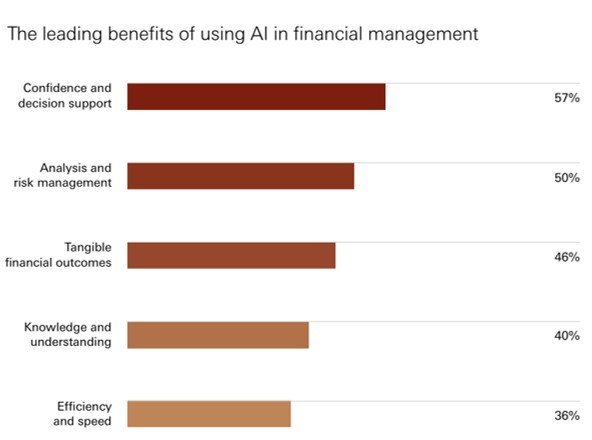
Source: HSBC: The Human-AI Advantage - A Global Affluent Report 2026
Three roles
The three roles that investors use AI for within finance and investment involve intelligence gathering: 66 per cent globally use it for research and analysis, compared with 51 per cent in the US; 50 per cent globally use it for strategy and 31 per cent as a second opinion for their own ideas.
When asked where their last investment idea came from, 62 per cent of those surveyed globally cited financial professionals and institutions, while a third named AI. This gap widens when making a decision with 12 per cent citing AI as the most influential factor in what they ultimately do with their money.
By contrast, 59 per cent of US investors said financial professionals and institutions were the source of their last investment idea while 19 per cent cited AI as the source. Fifty per cent of investors globally also prefer an AI-human hybrid approach, while US investors are more likely to choose a human advisor for due diligence and long-term financial planning.
Lavanya Chari, head of Wealth and Premier Solutions, International Wealth and Premier Banking at HSBC highlighted that before investors come to a decision, either to amend a trust or alter a portfolio, they turn to a person or an institution they trust. “They value AI as a research tool, but they want their ideas validated, blind spots identified, and their personal context understood,” she said.
In wealth management, Christopher Rossbach, CIO at J Stern & Co also sees AI as complementing the manager's role, making processes more efficient rather than replacing the human element. He thiinks the human touch and judgment will still be needed. The benefits of AI range from automating repetitive tasks, providing data-driven advice in specific areas such as portfolio optimization, risk management and tax analysis.
Another issue is how advisors should behave when they know clients use AI before and after meetings.