
Succession doesn’t usually fail through a collapse in structure. What tends to go wrong is that communications and preparations break down. The author of this article, Michael Ball, who is the founder and CEO of Narrative Office, a consultancy, explains the issue and why it matters. The topic of how to manage business and family succession is a well-trodden one but there are always new insights to be gained and fresh data to be discussed. We hope readers find this article of value, and to comment, please email the editors at tom.burroughes@wealthbriefing.com and amanda.cheesley@clearviewpublishing.com
The views of guest writers aren’t necessarily endorsed by the editors, but we value comments and conversations, so please get involved if you wish to do so.
Family offices are on the clock
With almost a quarter of enterprises expected to transition to successors within five years, 85 per cent of NextGens feel prepared to assume leadership, according to a recent BNY study, while nearly a third of office executives believe the opposite.
It’s a confidence gap that sits at the heart of a projected $100 trillion wealth transfer to heirs, which exposes a key readiness risk: Globally, more than eight in 10 ultra-high net worth families own or invest in an operating business, and less than 20 per cent plan to sell on retirement.
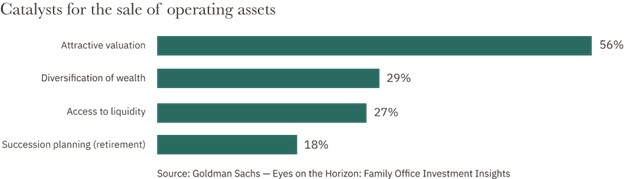
So here we enter a scenario that calls for a next generation of principals capable of steadily helming 10-figure businesses, as well as judiciously directing nearly as much in capital investments.
Except that’s not usually what we have.
Instead, if patterns hold to historical research, 70 per cent of this wealth is likely to be lost in the second generation and 90 per cent by the third. And while there is healthy debate as to the veracity of these oft-cited numbers, the controlling forces are consistent.
Most often, it traces back to the principal’s savvy and instincts that built the fortune itself: why a deal felt wrong despite the numbers; how to read a negotiation partner, when values override a return.
Transferring this kind of nuanced wisdom isn’t the primary frame for most next-gen prep. And with succession ticking down for many family offices, the window for making a meaningful shift will only narrow.
Roads well traveled
Mercer calls intergenerational transition “the ultimate challenge” facing family offices, owing to the significant complexity of conveying wealth, values, and leadership to successors.
Principals inherently grasp the imperative, citing it as their most important objective apart from asset preservation itself.
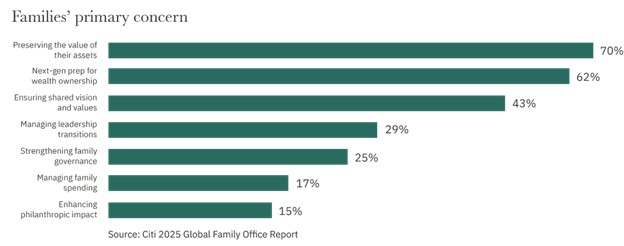
Unfortunately, while AlTi Tiedemann Global notes that almost half of family offices recognize successor unpreparedness as an operational risk, the standard package of education, governance structures, and business immersion isn’t fully standing up.
Indeed, despite significant investment, only 19 per cent of family members are currently satisfied with the NextGen teaching programs being delivered, as regards the Campden Wealth/RBC .
Family constitutions, charters, and the like, while offering important value in other aspects of governance, do little to prepare successors for complex leadership, and tend to suffer from the “folder problem” .
Far more promising is direct involvement in the enterprise, with board meeting attendance and seats on investment committees providing critical exposure to the inner workings of the business.
But even here, PwC’s recent NextGen survey found that successors often feel hamstrung by the principal’s reluctance to share authority. It’s a dynamic that maintains stasis and prevents children from earning parents’ trust to confidently hand over the reins.
The solution is not to tear down these core approaches, of course, but to implement a critical infrastructure layer that grounds, connects, and accelerates the system.
The missing discipline
In its 2026 report, JP Morgan found that nearly six in 10 global family offices identify the preservation of family values, governance, and legacy as a top strategic priority, yet less than half actively engage in measures to do so.
This data reveals a structural misalignment and calls for a review of The Williams Group’s seminal 20-year study – which discovered that succession doesn’t usually fail through a collapse in structure, but instead through a breakdown in communication and preparation.
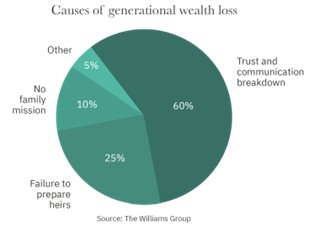
So, in a system effectively built to protect assets, but where the real risk is people, an updated design is required.
And based on a comprehensive bench of studies, the implementation of narrative into family offices delivers an outsize effect on intergenerational relationships.
The impact is so pronounced, it’s a discipline that merits its own name: narrative governance, which is the strategic capture and telling of principals’ most important life experiences, business insights, decision frameworks, and personal practices.
By aligning with more traditional governance disciplines, narrative elevates from its historically “soft storytelling” roots – dinner conversation, retreat exercises, legacy films – to fundamental risk mitigation.
EY points out that through different names, including “non-financial capital” and “family engagement,” the industry has already recognized that neglecting narrative weakens stewardship capabilities, diminishes business resilience, and introduces significant operational hazards.
And in the context of succession, we now also see that narrative is the missing governance infrastructure that helps to control the human variable and facilitates the communication and preparation that are so pivotal in protecting legacy wealth.
Preserving family IP
Artists negotiate rights, tech companies defend patents, and manufacturers guard trade secrets. Family IP is equally valuable, and demands the same level of documentation and protection as a core means of narrative governance.
This is what transforms essential wisdom into an accessible resource and consistent path to success for NextGens assuming the job.
It’s also what enables decades of pattern recognition, refined judgment, and gut instinct that exist only inside of principals to transfer to successors: informing capital deployment, risk analysis, partnership and people assessment, and so on.
Particularly because most family office governance practices are informal or unrecorded – and principals need additional assurance to confidently transition out – this preservation process only amplifies in importance.
Because succession can feel far in the distance until it doesn’t. And should an unexpected turn suddenly push family offices into a transition, they may be assuming more risk than realized by undervaluing narrative in their NextGen prep.
About the author

Michael Ball
Michael Ball is the founder and CEO of Narrative Office, a strategic consultancy that helps UHNW families transform timeless wisdom into decision-making and teaching tools for the next generation.
In designing the firm, Michael sought to apply his two decades of Fortune 500 storytelling experience – including for JP Morgan, Coca-Cola, SAP, Google, and Warner Bros – to help create family narratives that inform and inspire successors to carry the legacy forward. Based in Los Angeles, Michael holds a degree in psychology and business from UCLA, and works with family offices and individual clients all around the globe.