


Strategy
The New Geography Of Wealth
Citizenship and residency by investment, once viewed as an opportunistic strategy, has evolved into a deliberate component of wealth planning.
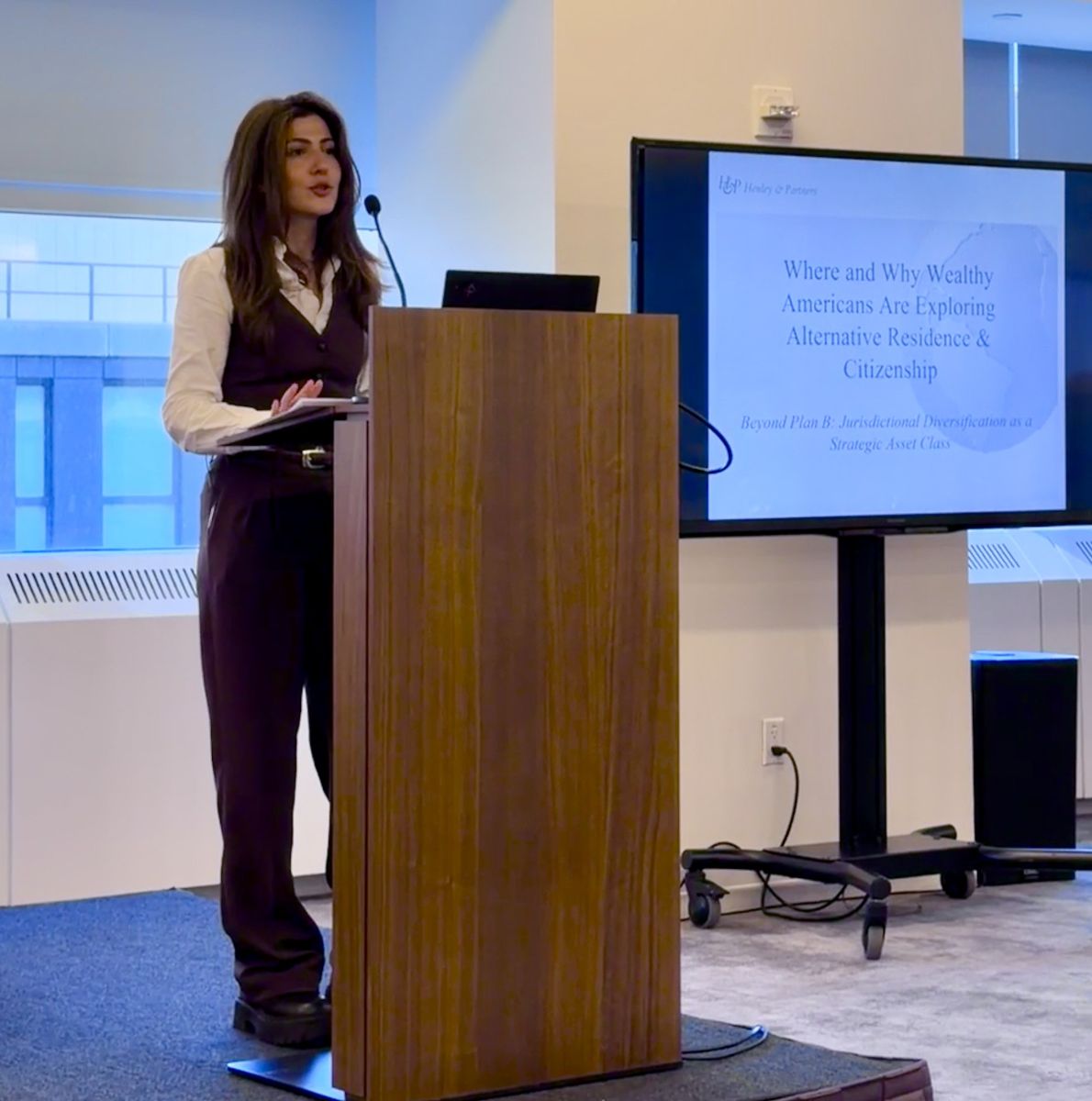
The following talk was given by Elena Scemama (pictured), at the Family Wealth Report Family Office Investment Forum 2026 in Manhattan, earlier in April. Scemama is an attorney and private client advisor at Henley & Partners, where she advises high net worth families on citizenship and residency planning within the context of broader wealth strategy. With a background spanning M&A, commercial roles, and business litigation, she brings a multidisciplinary and international perspective to questions of global mobility, risk, and long-term planning.
At a time when the world feels increasingly uncertain, shaped by the war between Ukraine and Russia, rising tensions between global powers, regional instability across parts of Africa and the Middle East, and the rapid, largely unregulated rise of artificial intelligence, the notion of stability has taken on a new meaning. For many wealthy American families, stability is no longer tied to a single country, but to the ability to move, adapt, and reposition across borders.
Citizenship and residency by investment, once viewed as an opportunistic strategy, has evolved into a deliberate component of wealth planning. What began as a macroeconomic tool to attract foreign capital is now increasingly driven by families themselves. US nationals have consistently ranked among the leading sources of demand, with applications rising meaningfully in recent years.
More importantly, the nature of that demand has shifted. With entry points ranging from approximately $105,000 to several million euros, and investment options spanning private equity, venture capital, real estate, and operating businesses, jurisdictional diversification is no longer ancillary. It is becoming a strategic component of portfolio construction.
In a world where uncertainty is constant, families are not only diversifying assets. They are diversifying where those assets, and their lives, are anchored.
Five drivers underpin this shift: global mobility, investment diversification, structural and legacy planning, tax considerations, and geopolitical risk.
Mobility in a fragile world
In 2020, during the Covid-19 pandemic, something unprecedented
occurred. US passport holders, long accustomed to one of the
strongest travel documents globally, found themselves unable to
enter much of Europe for an extended period. What appeared
temporary revealed a deeper truth: mobility is not static.
While a US passport provides access to approximately 185 to 190 destinations, that access remains contingent on external factors. Political decisions, regulatory changes, and global events can alter mobility almost overnight.
A second citizenship or residency introduces resilience. It expands flexibility and, in Europe, removes constraints such as the Schengen rule, which limits US citizens to 90 days within any rolling 180-day period. For families who spend extended time across jurisdictions, this is a material limitation.
In the Caribbean, where citizenship can be obtained within months, families gain speed, regional mobility through frameworks such as CARICOM, and easier access to alternative banking systems. For globally active families, mobility is no longer a convenience. It is infrastructure.
Capital allocation, reimagined
In a market estimated at $20 to $25 billion in 2025, families are
increasingly treating jurisdictional diversification as they
would any other allocation. It sits alongside equities, private
markets, real estate, and alternatives.
Risk today extends beyond markets to jurisdictions, regulatory systems, and currencies. As a result, concentration is no longer only about asset classes, but about where those assets are anchored.
Investing in mobility is therefore becoming as relevant as any traditional allocation. These programs allow families to deploy capital into familiar asset classes, whether private equity, venture capital, real estate, or operating businesses, but in different jurisdictions. In doing so, they gain exposure to new markets, currencies, and financial systems, reducing reliance on a single environment.
What distinguishes this allocation is that it converts capital into optionality.
The outcome is threefold. Families make a real investment, with returns tied to the underlying asset and risk profile. They diversify across jurisdictions and currencies. And they expand global mobility through residency or citizenship, embedding flexibility into their overall wealth structure.
Protecting generational wealth and family
If mobility and investment address the present, structural
planning addresses the future.
What begins as a single investment rarely remains confined to one individual. One applicant invests, yet the benefit extends to the entire family. Spouses and children are typically included, and in some jurisdictions, parents or even adult independent children as well. In the case of citizenship, the impact extends further, as it can be passed down to future generations, including those not yet born.
The result is exponential. A single decision translates into multiple residencies or citizenships across an entire family and over time. Families are not simply solving for themselves. They are building a durable mobility plan, embedding flexibility and access into generations that follow.
The implications are practical. Families gain access to public education, healthcare systems, and broader economic environments across jurisdictions. In many cases, it also removes employment constraints by eliminating the need for sponsorship.
What is being built is not simply mobility, but continuity.
Tax: A consideration, not a driver
In most cases, the decision to pursue a second residency or
citizenship is driven by optionality rather than relocation.
Families are making a thoughtful investment that expands mobility
while creating flexibility should circumstances evolve.
There are, however, instances where tax becomes more central. Some families choose to relocate and become tax residents elsewhere, often following a liquidity event or lifestyle shift. In those cases, jurisdictions are selected based on their tax frameworks.
These range from territorial systems such as Panama or Costa Rica to capped regimes and favorable inpatriate systems as seen in Italy, to time-limited exemptions such as Uruguay, and to zero personal income tax environments including Monaco, the United Arab Emirates, Antigua and Barbuda, St Kitts and Nevis, and the Bahamas. Switzerland offers structured lump-sum taxation for qualifying individuals.
For US families, mitigation mechanisms such as tax treaties, foreign tax credits, and the Foreign Earned Income Exclusion under Section 911 of the Internal Revenue Code may help manage exposure.
That said, this is not the typical case. Most families remain US-based and are not seeking relocation. In those situations, acquiring a second residency or citizenship carries no tax implications unless tax residency changes. US citizens remain taxed on worldwide income.
Hedging against uncertainty
The final driver is the most difficult to quantify, yet
increasingly the most relevant: uncertainty. Risk is no longer
confined to markets. It now extends to technology, regulation,
climate, and geopolitics.
Artificial intelligence is developing faster than regulatory frameworks can adapt. Climate risks are increasingly shaping long-term planning decisions. Geopolitical tensions continue to shift global dynamics. In this environment, additional citizenships and residencies are viewed as a form of insurance. Not against a single event, but against the accumulation of risks.
They provide something simple: the guaranteed right to an alternative. Where wealth has traditionally been diversified across assets, it is now being diversified across jurisdictions.
The range of options
The pathways available reflect a wide spectrum of objectives,
timelines, and investment profiles.
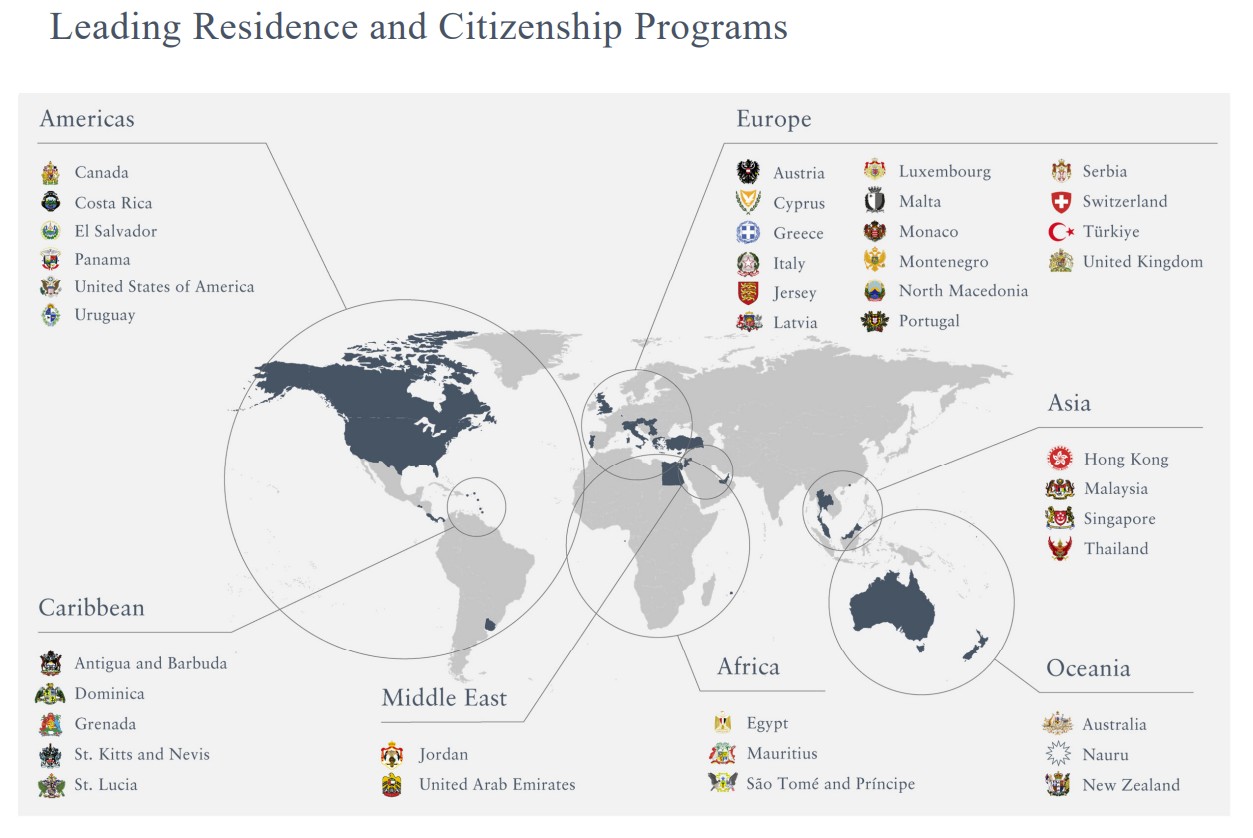
In Europe, residency programs remain among the most sought after. In Portugal, families can allocate approximately €500,000 into regulated funds spanning private equity, credit, or venture capital, with returns typically ranging from 4 to upwards of 20 per cent, leading to residency and, over time, citizenship. Italy offers a dual approach, combining relocation-based residency with investment pathways, while Greece provides residency through real estate investments starting at approximately €250,000 ($293,367)
Citizenship within the European Union is more selective and increasingly affirmed as citizenship by merit following the 2025 European Court of Justice decision concerning Malta. Citizenship in one member state confers the right to reside, work, and study across all 26 other European Union countries. Malta offers one of the fastest paths, while Austria provides more tailored pathways at a higher entry point, both operating through contribution-based models aligned with national interests.
Beyond Europe, the Caribbean offers a different value proposition. Programs are faster and more cost-accessible, with entry points starting around $230,000 and timelines of six to 12 months. These pathways extend to families and provide access to alternative financial systems and international banking relationships.
Further afield, jurisdictions such as New Zealand, Costa Rica, and Panama offer residency options aligned with relocation or lifestyle objectives. Costa Rica is attractive for its passive income pathways, Panama for its territorial taxation and real estate access, and New Zealand for its model allowing approximately $3 million into venture capital and private investments in exchange for lifetime permanent residency.
A strategic shift
What is most notable is not the expansion of these programs, but
the shift in how they are perceived.
Citizenship and residency planning is no longer ancillary. It is becoming an integrated component of wealth strategy.
In a world defined by constant change, stability is no longer tied to geography, but to the ability to choose.