


Tax
Billionaire Ballot Battle: Tax Issues Loom Over US’s 250th Birthday

Debates about reducing inequality of income and wealth on one hand, and the dangers of the impact on economies on the other, continue in the US. Tax has, ever since the country's founding, been a central feature of US political argument.
For a country founded in part on a tax revolt, it seems fitting that as the US approaches its 250th anniversary, taxation is looming as one of the major issues in the midterm elections – and beyond.
The marquee contest will be the California Billionaires Tax, a ballot measure that would require state residents with a net worth of at least $1.1 billion to pay a one-time 5 per cent wealth tax on their assets over five years.
Nationally, Democrats, who may take control of Congress next year, have introduced the “Ultra-Millionaire Tax Act of 2026” which would impose a federal wealth tax of 2 per cent annually on the net worth of households and trusts over $50 million, plus an additional 1 per cent surtax on net worth over $1 billion.
Across the country, over 100 new tax laws have been proposed in dozens of states, and Washington, Rhode Island and Massachusetts have either recently passed or proposed new laws boosting taxes on high earners.
In New York state, Democratic Socialists running on a “tax the rich” platform scored big primary wins in deep Blue districts, all but guaranteeing that three avowed socialists will be in Congress next year and more than a dozen will be in the state legislature.
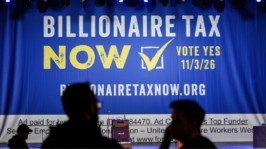
Source: The HILL, July 2, 2026
California, eye of the storm
For the next four months, all eyes will be on California. If the
Billionaire Tax Act passes, it would be the first law in the
country to tax wealth and not just income, marking a new era in
tax policy.
Needless to say, wealthy taxpayers aren’t going down without a fight. Google co-founder Sergey Brin and others have poured nearly $100 million into support for two ballot measures which directly compete with, and are designed to obfuscate, the wealth tax proposal, which mandates that 90 per cent of the revenue collected be spent on healthcare and the rest on education and food assistance.
One of the rival measures prohibits new taxes on personal property and financial assets and the other requires audits of programs funded by new taxes and contains a provision that could invalidate a new wealth tax.
The battle of the tax ballot is expected to be close, hard fought and very expensive. The Service Employees International Union-United Healthcare Workers West, which introduced and formulated the wealth tax, is sparing no effort to mobilize across the country’s most populous – and, not coincidently, richest – state and arguably has a head start, with polls showing a majority of voters favoring the proposal.
But Brin and company are expected to wage an equally fierce campaign to defeat the ballot measure and/or steer voters to support their counter proposals. Under California law, if both the wealth tax and a countermeasure pass, the one with the most “yes” votes becomes law.
In a classic case of politics making strange bedfellows, the billionaires have unexpected allies: Democratic governor and likely presidential contender Gavin Newsom, the California Teachers Association, Planned Parenthood and various labor unions all oppose the wealth tax.
(See an article on mitigation strategies around a potential federal wealth tax.)
Context: concentration of wealth
The backdrop for the California proposal, the rise of Democratic
Socialists in New York and legislation targeting wealthy
taxpayers across the country has been an ongoing, raging national
debate about inequality, fairness and the fast-growing
concentration of wealth.
Proponents of imposing more taxes on millionaires and billionaires cite statistics like the share of the country’s total wealth held by the top 0.1 per cent of the population soaring to over 14 per cent, the ratio of CEO to worker pay ballooning to 200 to 1, and the wealth of the country’s dozen wealthiest families now being 200,000 times more than the wealth of the average household.
According to one recent poll, 84 per cent of the public believes that the wealthiest Americans have too much power. There is an influential contingent of wealthy Americans who agree, and have formed the “Patriotic Millionaires” organization, which advocates for higher taxes on the wealthy.
Economist Gabiel Zucman, one of the architects of the California Billionaire Tax Act, has framed the debate in stark terms, positing that “democracy versus oligarchy is going to be the battle of the 21st century.”
Context: “Why democracy needs the rich”
But defenders of the current system are also making their voices
heard. In his new book Why Democracy Needs the Rich: The
Hidden Benefits of Wealth in a Free Society, John
McGinnis, a law professor at Northwestern University, cites the
role of wealthy individuals and business owners in driving
growth, jobs, innovation and contributing to tax revenue.
Indeed, a particularly popular argument is the large share of taxes the wealthy already pay. In California, the top one per cent of taxpayers, including, to a large degree, the state’s estimated 250 billionaires, pay about half of the state’s total income tax revenue.
The Institute of Economic Affairs in the UK argues that those concerned by wealth inequality should focus on increasing wealth for people who have less of it, rather than taking wealth away from those who already have it. The wealth tax is not a tool for wealth redistribution, the institute argues, because it is ultimately paid out of income, while actual assets remain in place and are not transferred.
Do tax hikes cause an UHNW exodus?
More specific issues have also emerged in the wealth tax debate.
Opponents claim a wealth tax is unprecedented and
unconstitutional. Proponents counter that property taxes, which
are widespread and critical for local tax revenue, are in fact a
tax on an asset, not income.
Perhaps the most persistent critique of a wealth tax is that those affected will simply leave that jurisdiction and take their wealth, income tax revenue and possibly businesses with them. In fact, some high-profile Californians, including Brin, Google co-founder Larry Page and venture capitalist Peter Thiel, apparently scared off by the possibility the Billionaires Tax will pass, have in fact already left the state.
But research by The Fiscal Policy Institute found that wealthy residents of New York, the second highest taxed state in the country, were less likely to move out of state than those in other income groups, and they did not leave in large numbers after a major tax increase in 2021. In fact, the number of millionaire tax filers in highly-taxed New York City has increased by 36 per cent from 2014 to 2023.
The narrative of the rich fleeing after a big tax hike is largely a myth, according to Zucman. “There’s not a zero response,” he told the New York Times. “But it’s very small.”
Wealth tax proponents concede that the very wealthy do in fact pay a large portion of state and federal income tax revenue. But they argue that that amount is a miniscule proportion of their total real income, much of which is derived from assets which are not taxed at all. Even the payroll tax, which is capped at $184,50, barely impacts them.
Legal tax avoidance
Billionaires can avoid taxes by avoiding traditional earnings,
paying themselves little or nothing and accumulating wealth
through stock shares and options, Boston College Law School
professor Ray Madoff points out in Second Estate: How the Tax
Code Made an American Aristocracy. When those shares
are sold, they are taxed as capital gains at a much lower rate
than earnings from a salary.
“Because of this difference in tax treatment, someone who earns $50,000 from working a job pays higher taxes than someone who makes $50,000 from selling an investment,” professor Madoff wrote.
What’s more, banks and private credit firms will happily lend money at favorable rates to ultra-high net worth individuals who can use valuable stock and other assets such as art and property as collateral – another means of forgoing the need to declare taxable income.
Additional legal avoidance strategies and structures available to wealthy individuals such as estate tax loopholes, limited partnerships and complex irrevocable and grantor trusts underscore the need to even the playing field, according to wealth tax advocates.
“Congratulations! You won capitalism!”
Calls for tax fairness aren’t confined to socialists and
academics. On April 15, also known as Tax Day, Patriotic
Millionaires trolled Amazon founder Jeff Bezos’ Washington, DC
mansion with signs exclaiming “Congratulations! You won
capitalism! Now pay your damn taxes.”
If the California Billionaires Tax is approved by the voters, it faces certain court challenges. In the meantime, wealth managers will be scrutinizing the fine print for guidance on matters such as valuation, sourcing liquidity and residency requirements.
As July 4 brings issues like taxation that have riven the country since its inception to the fore, the wealth tax debate may come down to an existential economic question: is it “economic self-sabotage,” as critics charge, or is it indispensable in addressing the need to tap a massive source of wealth to benefit the needs of the public?