


WM Market Reports
BNY Wealth Lifts Lid On UHNW Wealth Transfer Readiness, Confidence

Covering topics from financial literacy through preparations for transfer and use of trusts, the report examines how UHNW individuals are handling financial affairs.
The air is thick with commentary about the multi-trillion-dollar intergenerational wealth transfer that is happening. It drives much of the strategy that private banks, wealth advisors and family offices engage in, including the level of M&A affecting the sector.
It appears, however, that ultra-high net worth individuals still have work to do in getting plans in place, according to a survey from BNY Wealth.
In a 43-page Wealth In Motion report, BNY Wealth said that 47 per cent of the UHNW people it interviewed said comprehensive transfer plans are in place; 53 per cent acknowledged that plans are not complete.
BNY Wealth took views from 501 ultra-HNW individuals with at least $10 million of investible assets. Some 78 per cent of respondents were male and the rest were female. The single largest age segment – 35 to 44 years – accounted for 33 per cent of the total.
The report ranges over topics such as wealth protection structures, tax, business transfer planning and, inevitably, AI.
In a breakdown of transfer plan elements, the survey found that 71 per cent of respondents have a healthcare directive/living will, and 69 per cent have a will; 63 per cent have a durable financial power of attorney; 50 per cent have set up a revocable trust; 44 per cent are coordinating assets, such as assigning titles or providing funding; 43 per cent have an irrevocable trust; 37 per cent have consolidated their finances; 36 per cent have charitable vehicles and 31 per cent have set out a business succession plan.
Strikingly, the report found that more than half of those surveyed said they haven’t reviewed their plan with an advisor in the past year and about 24 per cent of them haven’t updated it in at least three years.
It is unsurprising that such findings are part of wealth management conversations given the vast sums on the table. To give an example, a December 2024 report from Cerulli Associates said that wealth transferred through 2048 will total $124 trillion; $105 trillion is expected to flow to heirs, while $18 trillion will go to charity. Nearly $100 trillion will be transferred from “Baby Boomers” and older generations, representing 81 per cent of all transfers. More than 50 per cent of the overall total volume of transfers ($62 trillion) is expected to come from those who are currently HNW and UHNW, which together make up only 2 per cent of all households.
One of the reasons why, FWR hears, is that with so much wealth sector M&A and consolidation, firms are seeking scale and resources to handle the increasingly complicated demands of clients undergoing this transfer process. (See articles here and here.)
Mistakes, lessons and plans
At the 60th Annual Heckerling Institute on Estate Planning, BNY
Wealth said it surveyed trust and estate planning experts about
their clients’ top mistakes heading into 2026.
“The most commonly cited issues point less to a lack of engagement than to the complexity of wealth transfer planning itself. Specifically, 39 per cent said the families they advise may not be fully aware of or fully understand their estate plans, while 26 per cent cited asset titling issues and another 19 per cent pointed to outdated documents as common mistakes,” the report said.
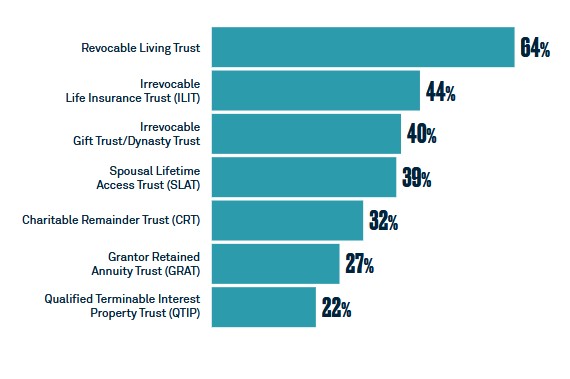
In other findings, two-thirds of families said that they have at least one trust, with the average number of trusts being almost three.
The chart below shows the type of trusts being used.
Source: BNY Wealth
Confidence
The report said that most (67 per cent) wealthy individuals
report high levels of confidence in their plan’s ability to meet
their objectives.
“This confidence appears to stem from several factors, including the belief that their plans are well structured, trust in the advisors helping guide the process, and a sense that their planning is aligned with both current needs and long-term goals,” the report said.
As expected, AI makes an appearance.
The report said AI is emerging as a popular starting point for learning about wealth transfer, particularly among younger UHNW individuals. This point chimes with articles in FWR discussing clients’ use of AI ahead of, and after, their meetings with advisors.
“Among decision-makers under age 45, 64 per cent report using AI to better understand planning strategies. While these tools can help build foundational knowledge and prompt early exploration, they remain limited in their ability to account for the full complexity of wealth transfer decisions, including personal circumstances, family dynamics and rapidly evolving tax and estate planning laws,” the report said.
The report reveals anxieties, such as financial literacy – or the lack of it. Some 42 per cent of respondents said they fear that their heirs are insufficiently financially literate; 45 per cent said heirs have limited experience of handling significant amounts of money.