


Practice Strategies
Marketing Study: Referral Paradox, Rise Of AEO And Advisor Antipathy

How do advisors find new clients? The answer, it seems, is not as obvious as some practitioners in the sector might assume.
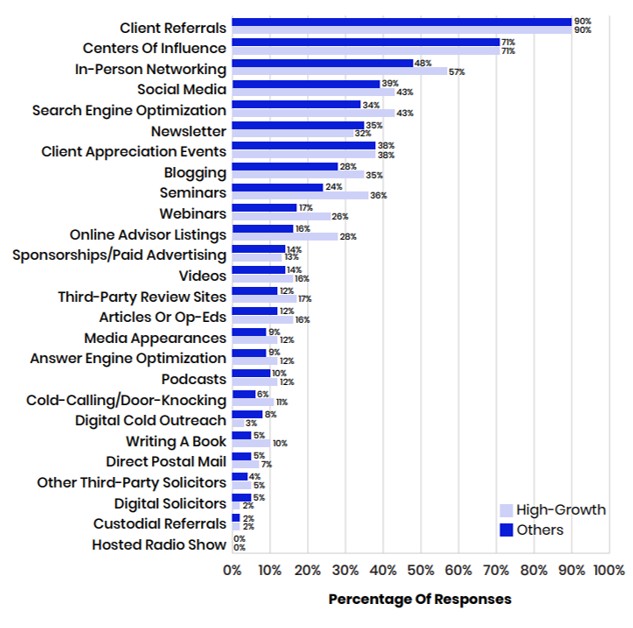
Referrals may be the lifeblood of new business for advisory firms, but according to the latest Kitces Report marketing study, the fastest-growing RIAs are less reliant on referrals from clients and so-called centers of influence (COIs) such as accountants and attorneys.
That paradox is among several noteworthy findings in Kitces’ bi-annual report, How Financial Planners Actually Market Their Services, which includes the rise of answer engine optimization (AEO), the advantage of niche practices and the importance of reducing the amount of time senior advisors spend on marketing.
Referrals from clients and COIs are by far the two marketing tactics most widely used by RIAs, according to a survey of advisors conducted for the report. Yet what Kitces calls “high-growth” firms rely more on “tactics over which they have greater control, rather than being fundamentally reliant on actions taken by clients.”
Client referrals and COIs are inherently passive tactics, noted Mark Tenenbaum, director of Advisor Research for Kitces and a co-author of the report. “The advisors’ input doesn’t impact the outcome,” Tenenbaum told Family Wealth Report. “What’s more, the referral well eventually runs dry.”
“Doom loop of slowing growth”
While newly acquired clients replenish the pool of clients with
untapped networks, those new clients represent an increasingly
small share of the firm’s growing client base, Tenenbaum said.
“As a result, fewer clients as a percentage of the total client
base remain capable of generating new referrals,” he explained.
“That leads to a declining referral-driven growth rate, which in
turn produces fewer new clients to replenish the referral pool,
creating an absolute doom loop of slowing growth.”
When referrals decline, “there is often little an advisor can do to immediately reverse the trend.” Another downside, according to the report: while advisors can theoretically increase referrals by simply asking clients for them, “doing so not only fails to increase referral volume, but actually appears to reduce it by causing clients to feel repeatedly solicitated.”
Marketers need to vary their tactics, said Liz Thomas, chief marketing officer for Diversified Trust. “We’re looking for more ways for the right people to encounter the firm on their own,” Thomas said. “There shouldn’t be one single touch point.”
Diversified Trust emphasizes personal interaction between prospects and advisors at events, dinners, seminars and retreats. “Thoughtfully curated gatherings with small groups where people can learn from each other” are especially effective," Thomas said.
Questions surrounding AEO
The report also highlighted, for the first time, artificial
intelligence-driven answer engine optimization, which
attempts to influence content to appear in AI-powered
search platforms, and is being rapidly adopted by RIAs.
“I think AEO levels the playing field and will be a good asset,” said Kristin Andree, founder of My FA Coach. “It’s a positioning opportunity for AI agents to find the firm. But advisors need to be clear on who they serve and how they can help.”
However, AEO currently has a very high Revenue Acquisition Cost (RAC) at $3.45, according to the Kitces study, meaning firms have to spend $3.45 for each new $1 in revenue.
AEO may well become more efficient as it matures, but AI-powered search tools may also “ultimately fail to gain widespread traction among consumers seeking advisor recommendations,” the report noted. In fact, recent reports have demonstrated how easily large language AI models can be manipulated into providing “answers” to search queries that are false, undermining public trust.
Niche advantages
Smaller RIAs with a distinct brand appear to have a marketing
advantage. RIAs with a well-defined niche and a clear target
market that accounts for at least 75 per cent of new clients
are consistently overrepresented among high-growth
practices with up to $1 million in revenue, according to the
report.
“Niche firms also tend to be better at keyword-based SEO [search engine optimization],” Tenenbaum said. What’s more, niche firms are often better suited to aligning marketing tactics such as sponsoring events aimed at their target market, according to Andree. She cited one of her RIA clients that works with professional basketball players having great success hosting client events at the NBA Summer League games in Las Vegas. (See a recent sports/wealth article in FWR here.)
Less advisor time on marketing leads to better
results
Marketing remains highly problematic for RIAs, according to the
Kitces study. The typical advisory practice spends 7 per cent of
annual revenue on marketing, the study found. However only 2 per
cent of that spend went toward “hard costs” such as software
and directory listing fees, compared with less efficient
“soft costs” of advisor and staff time.
Indeed, the study emphasized “how much advisors disliked marketing relative to other tasks.” Those advisors who spent the most time marketing pose “a higher turnover risk,” according to the report.
The “anti-scaling nature of advisor time” drives up the cost of acquiring clients organically compared with inorganic M&A costs. High-growth firms, the reports said, “figure out how to become less and less reliant on increasingly expensive advisor time as they grow.”
Senior advisors at high-growth firms are willing to sacrifice some compensation and reinvest those dollars into hard-dollar marketing spending, the study found.
“This strategy enables firms to provide greater staff support while deploying hard-dollar marketing tactics that are less expensive than relying on senior advisor time,” according to the report. “It also scales more effectively as firms grow, because marketing outcomes can be expanded by leveraging relatively fixed investments, such as marketing staff salaries and other centralized marketing resources.”
In addition to delegating more marketing tasks to support staff, high-growth firms use inputs from sources such as clients surveys, conferences and industry research when constructing marketing plans and subsequently have systems in place to track prospects. They also maintain listings in online advisor directories and focus on in-person networking at events, which can be scalable and controllable.
Keeping advisor time under control is critical, the report concluded. The most efficient firms not only market less, “but become progressively less reliant on increasingly expensive advisor time as they grow.”