


Investment Strategies
China, Alts And AI In Investment Summit Spotlight

At a conference this week hosted by Family Wealth Report, there was plenty of sharp debate and commentary about issues such as whether China is investible, the risks in areas such as "alternative" investments, and the outlook for AI. Our US correspondent was there to cover the action.
China has gone from “a growth factor to a risk factor,” said Jesse Friedlander, chief investment officer for Des Voeux Partners Family Office, speaking at this year’s Family Wealth Report Family Office Investment Summit.
Government intervention has made it hard to take advantage of China’s growth, but investors who monitor the country’s politics and markets closely can still take advantage of “selective” investment opportunities, Friedlander said.
Lu Zhou, CEO of Vanquour Wealth Management, forcefully disagreed. “I don’t think China is investible,” Zhou said, citing “extraordinary concerns” about the country’s “combustible” state of affairs. Investors in the unpredictable and “very volatile” Chinese equity markets have lost money over the last 30 years, she maintained. Even investors who have seen positive returns may have trouble getting their money out of the country, Zhou added.
Alts “wall of worry” building?
Caution is also required for private credit and alternative
investments, said Stuart Katz, chief investment officer of
Robertson
Stephens. Noting rapidly maturing loans and climbing interest
rates, clients are asking when the “wall of worry” is going
to hit, Katz said. When constructing portfolios, Robertson
Stephens looks for real return, maximum drawdown and cross-asset
correlation, Katz said.
When vetting fund managers, credit and alternative investment specialist Rajneesh Vig said he looks for firms with a specialization that can retain and incentivize talent, while avoiding managers with a high staff turnover.
Vig cited Warren Buffet’s adage that he’d rather buy a wonderful company at a fair price than a fair company at a wonderful price and another admonition he said applied to alternatives: when an investment begins to go south “it’s never too early to take action” to mitigate value erosion.
AI hyperscalers “not overvalued at all”
AI investments got a thumbs up from speakers at the conference,
held at venue partner PwC’s global headquarters in New York.
Hyperscaler investors should receive “a very high return on
capital,” according to Van Azadian, CEO of Spark Capital
Management. “I don’t see those companies overvalued at all,”
Azadian said.
Ari Smith, founder of the Cognitive Coefficient Institute also boosted AI, declaring that by being able to “manufacture cognition,” humans have “crossed an extraordinary threshold. Nothing in history has ever been like this.”
The ability of family offices and wealth managers to use AI was also scrutinized. Smith was optimistic, predicting that the family office of the future would become an “intelligence institution” using AI-aided cognitive and biological capital to enhance both the wealth and wellbeing of family members.
Humans “biggest AI bottleneck”
Azadian who, remarkably, is still a student at New York
University, said wealth advisors may have challenges in the short
term because only young people will be able to fully maximize
AI’s capabilities. Smith scornfully dismissed Azadian’s claim,
but Alek Turkmen, founder of Silk Capital
Management, also in his 20s, made a similar
controversial assertion.
While the received wisdom is that there needs to be a human in the AI loop, Turkmen said that artificial intelligence will be so advanced in five to 10 years, that a human in the loop will actually be “the biggest bottleneck” to an AI system.
Right now though, investing “time and culture in AI adoption is the single most important investment” wealth managers can make, said Michael Edwards, independent director for Forum Markets. When implementing AI, advisory firms shouldn’t let one “single point of failure” disrupt a project, Edwards said.
“Never assume the first report from AI is the
answer”
When testing an investment thesis, he suggested setting up
separate human and AI-lead teams as an exercise and measure the
results from each against the other. “Never assume the first
report from AI is the answer,” Edwards cautioned.
When setting AI policy, make sure tools and use cases are approved, said Joseph Haddock, managing director at MultiMix IT. When testing, firms need to make sure they know how a new system fails, he added. And when firms build secured AI agents, they must define exactly what the agents do, said Hugo Gonzalez, managing director and head of private equity and venture capital at HalcyonFT.
“Alpha is in privates”
Boosting private markets, Caplight director of business
development Adam Crawford pointed out that 85 per cent of US
companies with more than $100 million in revenues are now private
and that late stage venture capital is a $10 trillion-plus asset
class. “Alpha is in privates,” Crawford asserted.
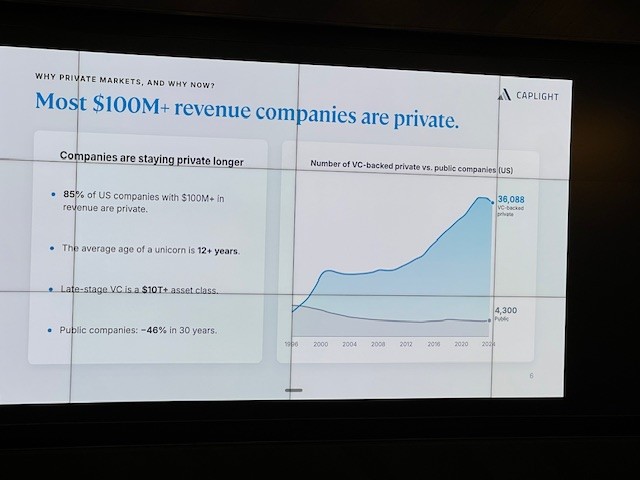
Illustration of private market investment performance
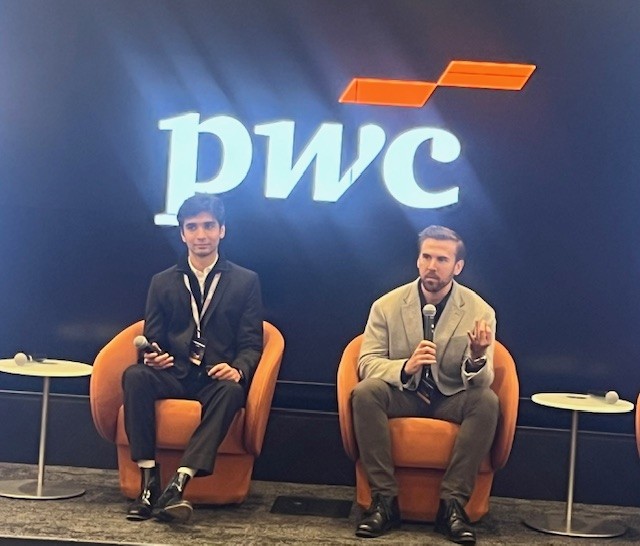
Family offices can and should take advantage of General Partner (GP)-led co-investing, said Siddharth Somani, a Caplight markets associate. A GP syndicates its excess allocation to a select group of limited partners, Somani explained, who can in turn invest alongside the GP in the primary financing round, while also benefiting from the GP’s shared due diligence.
Siddharth Somani, left; Adam Crawford
Family offices must “upskill to build AI
fluency”
Family offices are also adapting to generative AI, said Belinda
Sneddon, managing director, family enterprise advisory services
for PwC, the conference’s
venue partner. Common use cases that PwC is seeing in family
offices now, Sneddon said, include portfolio company analysis,
performance reporting and analytics, cash forecasting, drafts and
communication, operations and administration, learning and
development and family services.
But for AI to be effective, family offices teams have to adapt as AI capabilities evolve, teams have to “upskill to build AI fluency” and frontier tools need to be leveraged to “unlock capabilities,” she said. In addition, data has to be protected and access controlled, workflows must be connected and work has to be redesigned around people and AI.